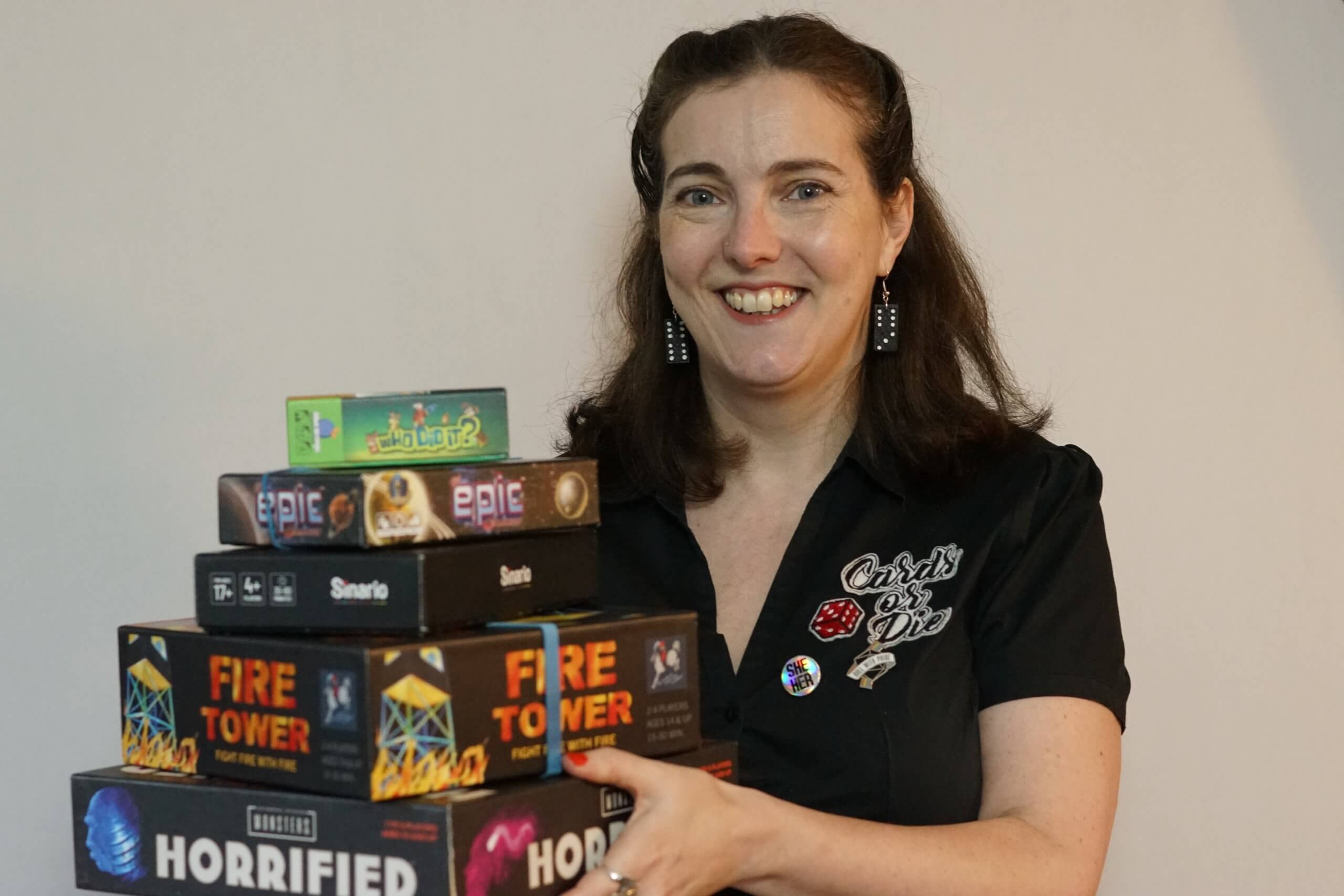
People often ask me which game is my favourite and that’s a very tricky question as it varies day to day. It depends on lots of things – how tired my brain is, who I’m with, what mood I’m in, what I’m obsessed with at that particular moment. So when I went on Radio Leeds just before Christmas and had about 20 minutes to come up with my all time top 10 board games it was quite a challenge! Ask me on another day and you might get a slightly different list but it would be very similar. So…. here goes and in true top 10 tradition we’ll start with…
Number 10! Flip 7.
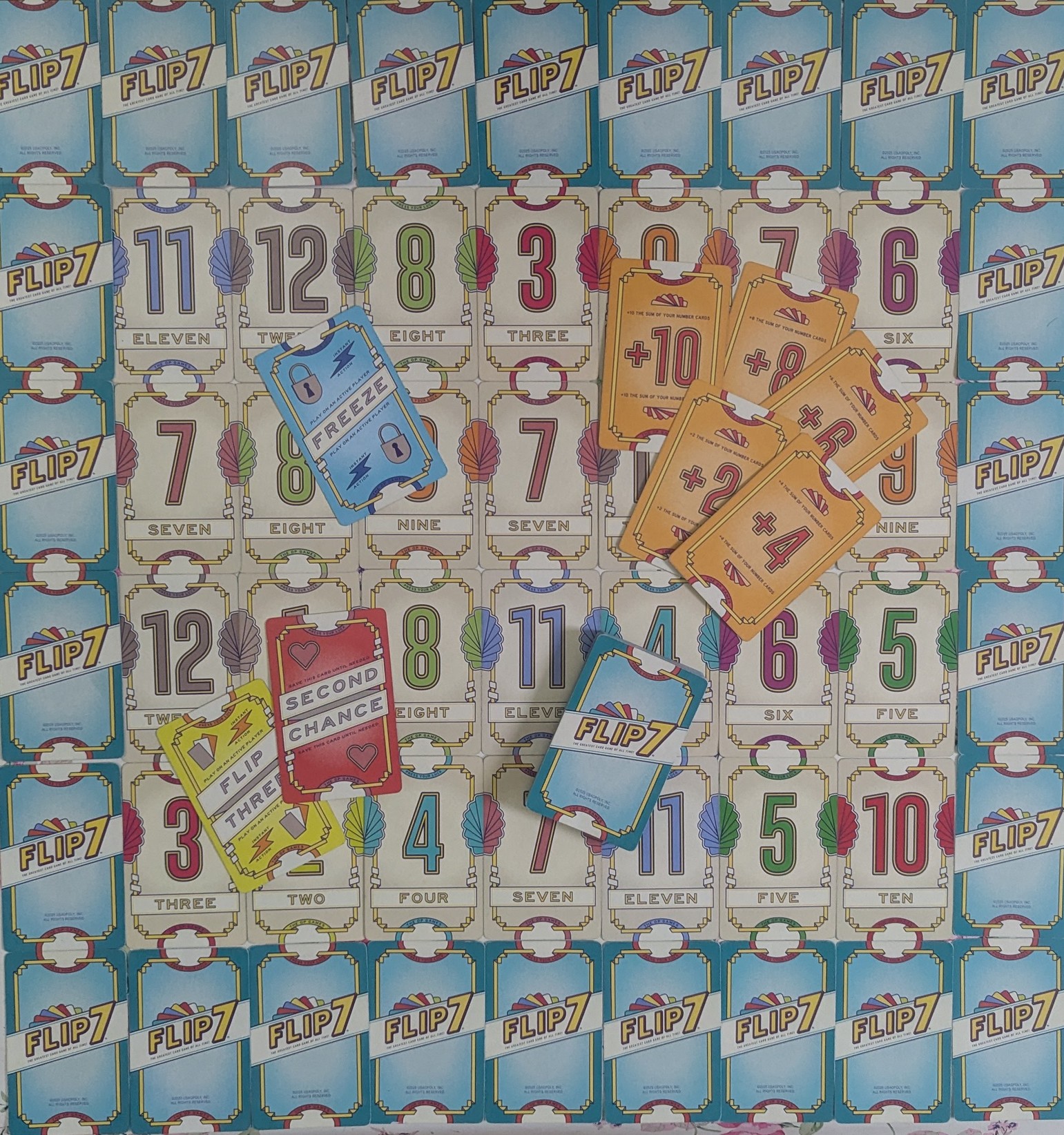
This is still a relatively new game to me. It’s super easy to learn and play and involves a lot of pushing your luck (something I love and am simultaneously terrible at). Turn over cards until you lose your nerve and bank your points; you get two identical number cards and go bust or you flip 7 different numbers ending the round and scoring you bonus points!
There are extra cards which contain scoring bonuses, allow you to freeze someone out of the round, give you a second chance and let you pick up extra cards or make someone else pick up extra cards. This and the fact that you know how many of each card is in the deck make for some delicious calculations when the choice to flip or bank comes your way!
I have not taught this game to anyone who hasn’t loved it. That in itself is amazing. No one has even felt ‘meh’ about it. I teach it and people play it again and again – all ages, all interests, all abilities.
9. Draw My Face
I absolutely love Gamely Games – their games are always good fun and come in small boxes which makes them great for shoving in your bag and taking them out and about with you. Draw My Face is brilliant. It’s not really competitive which often I’m very happy with.
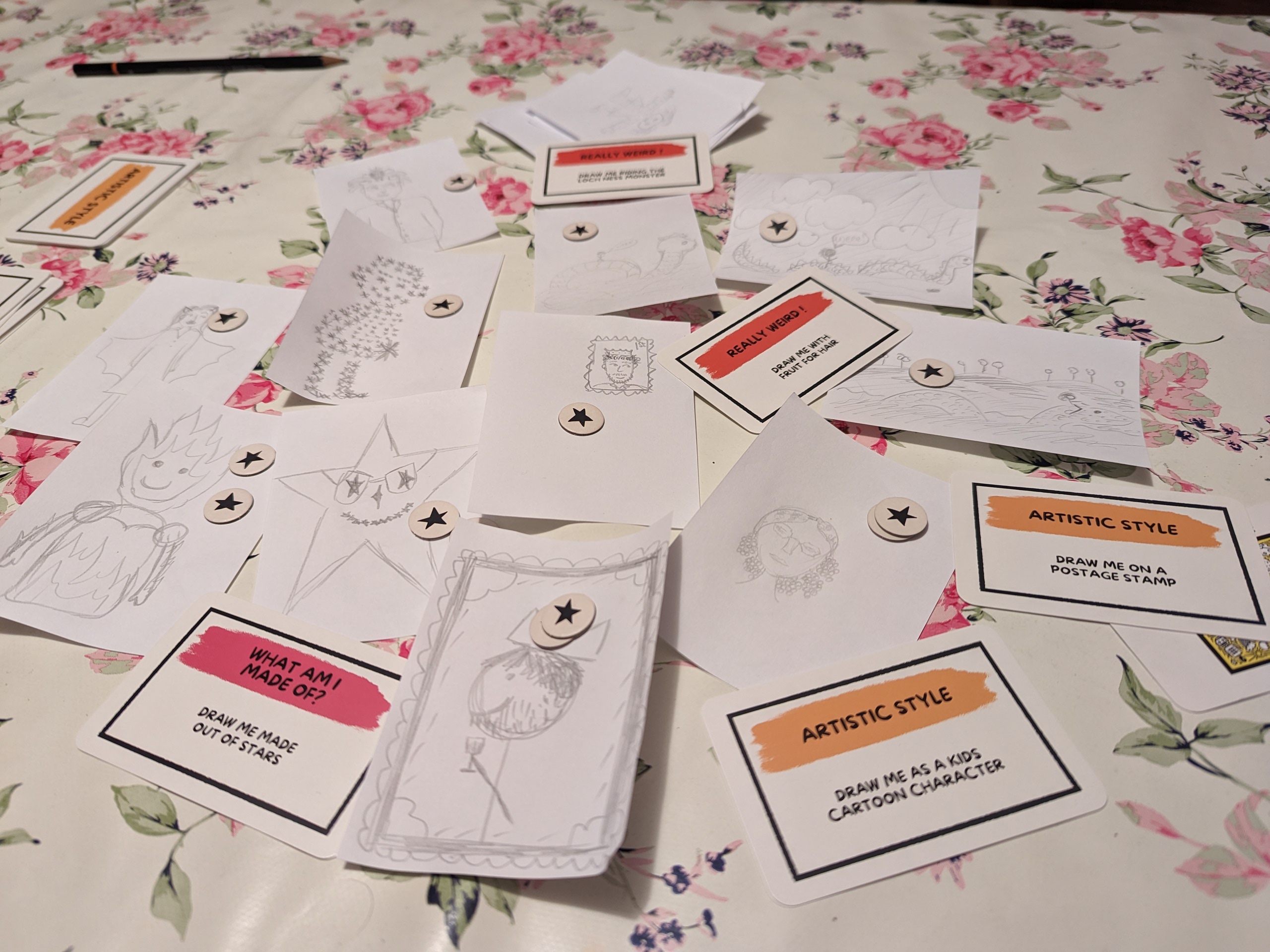
No artistic skill is required for this one – in fact not having so much skill may put you at an advantage in some of the challenges. When you have to use only two fingers or draw someone entirely made up of stars you won’t be so disappointed when it looks ridiculous!
The aim of the game is to draw each other following the prompts that you choose and then at the end you lay out all of your portraits (and hum the Tony Hart Gallery theme if you are of a certain age) then vote for your favourites. You get three votes each and the best (or funniest) wins.
8. Calico

This one is a proper brain burner from Flat Out Games who created some of my most loved games. They are all beautifully illustrated with gorgeous components. This one is illustrated by Beth Sobel and based on real life cats. Calico sounds lovely – you are making a quilt, attracting cats and adorning your beautiful quilt with fruity buttons. Turns are also super easy – pick a tile from the three in front of you, play it onto your board, replace it from the store. However…
if you really want to maximise your score (which of course you do) as well as attracting kitties and choosing buttons you’re going to need to focus on the scoring tiles which are placed on your board during set up. Honestly, I’ve never got past the starting tiles and I am fine with that, but you can make it harder if you want more challenge. These involve scoring extra for playing tiles in a certain configuration – there are three different requirements on the board for you to fulfill. You can fulfil them by pattern or colour or for maximum points by both. For instance one tile should be surrounded by all different quilt tiles, another should have pairs of tiles and the third – three of one type and three of another. And you know they overlap!
I love this game because it is so puzzly and tricky and beautiful. It is tricky but because learning it is so easy and turns are easy it’s great to immerse yourself in. It really gets inside my brain and pushes all of the other stuff out. Which frankly, in this economy, I am all for.
7. Azul


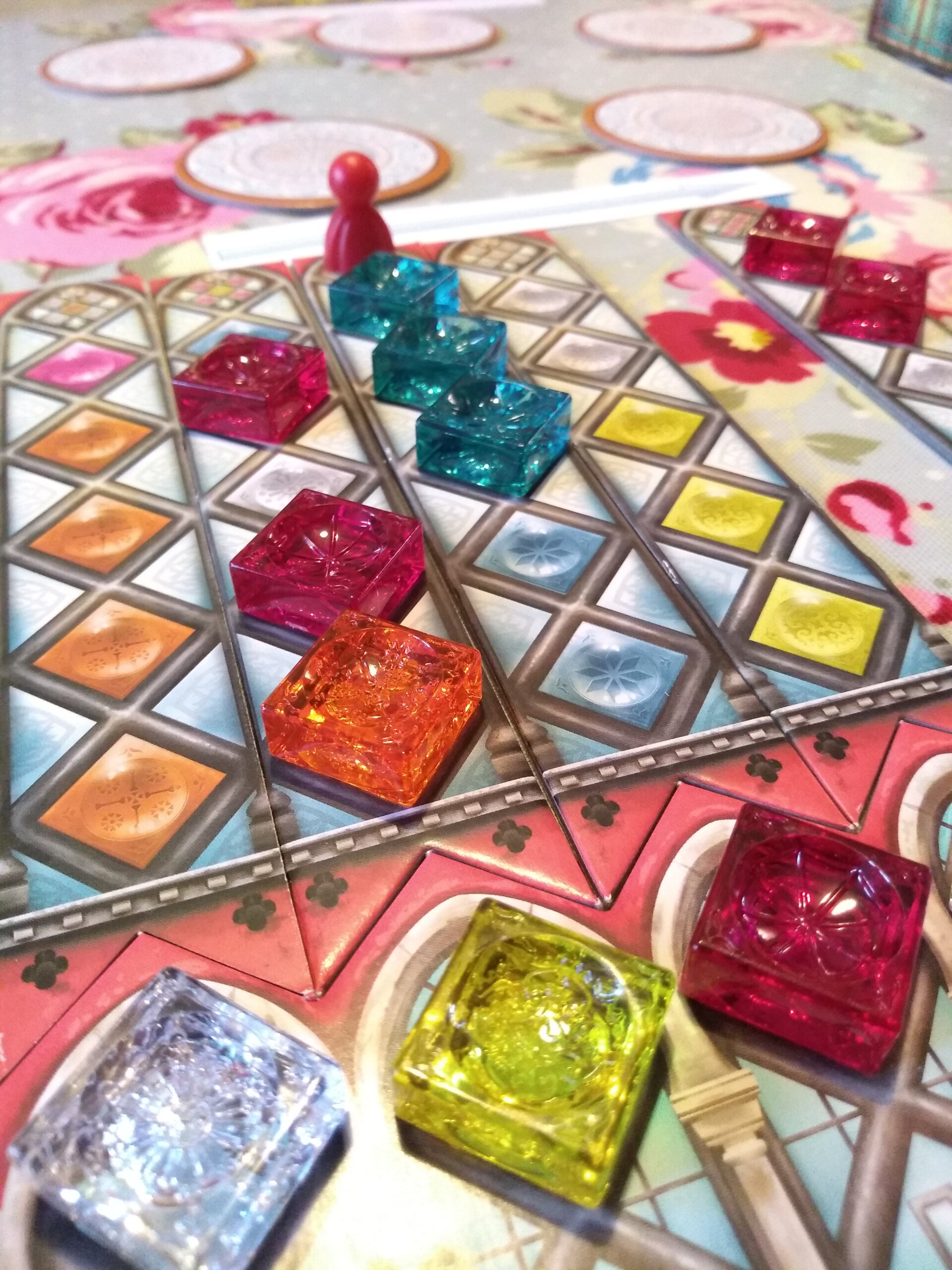

After seeing Calico at number 8 in my top 10 games, this will not come as a surprise. I have three versions of Azul – the original (there are two images of this), Stained Glass of Sintra and Summer Pavilion. (The images are in order). I really enjoy all of them – the newer versions have been similar enough so that they are easy to learn but different enough that it can depend what mood I’m in as to which I play.
My most played version is the original which I find the easiest. It isn’t too taxing and allows me to lose myself in the game even when I’m tired or feeling easily distracted. All of the games have beautifully tactile pieces. Sintra, in particular, looks edible! Although it is competitive in the sense that the person with the highest score wins, really you are concentrating on your own aims and trying to maximise your score, probably keeping an eye on other people’s scores. But playing to mess other people up can really backfire so it usually isn’t worth it.
In the original, you are decorating the walls of the Royal Palace of Evora with a beautiful mosaic which you hope will suitably impress the King of Portugal. Each round you draft tiles by taking them from the factory onto your planning board. Once all the tiles in the factory are used up then you move tiles from completed rows across to the wall. You score points for laying tiles adjacent to existing tiles and then at the end you score bonuses for complete rows, columns and sets of colours.
So, in planning you are attempting to play tiles in the best order so that your points quickly stack up and then ending the game by completing a row at the best time for you. There’s a lot of thinking and planning; and rethinking when the tiles you want don’t come out or someone else uses them! It’s one of the games we play most in our house. If you love a cosy, tactile game – you’ll love Azul.
6. Cluedo
I couldn’t not include this classic in my top 10 favourite board games. Although I very rarely play it any more I do play games inspired by it. The amount of versions of it available speak to how popular it still is after more than 80 years! It was a family favourite in my house growing up and then a favourite of my children too so it holds lots of very fond memories for me.
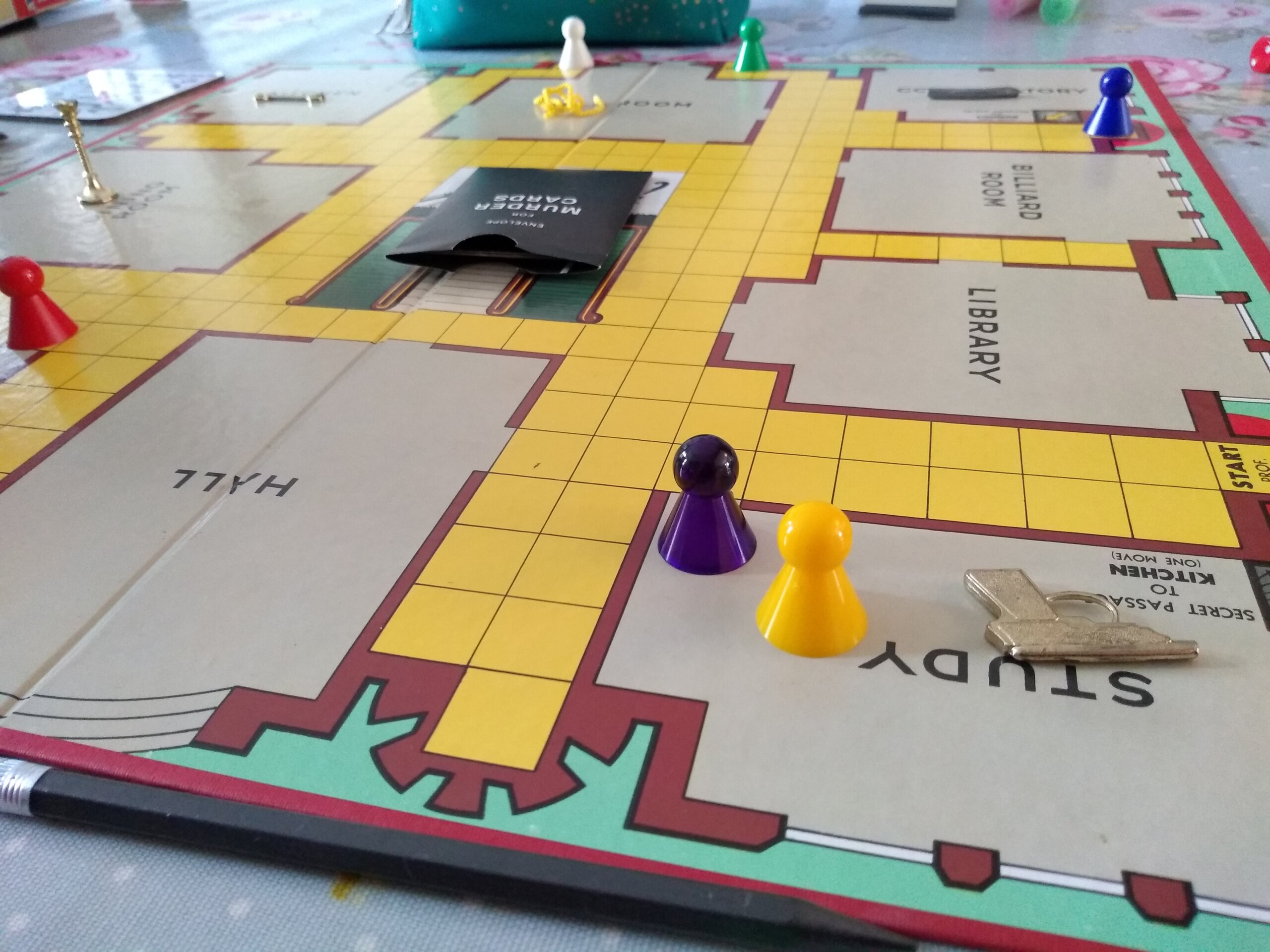
Like Monopoly, it is difficult to find anyone who hasn’t played Cluedo and it’s difficult to find anyone who has actually read the rule book. Vintage rule books are one of my favourite things so I’m going to treat you to a small snippet under the heading Preparations for Play:
“(The rules of an intriguing and interesting game must inevitably seem to be slightly boring, but these rules have been drawn up as briefly as possible, and with a little concentration, should be easily assimilated by following out each act carefully and in its proper order.)”
I don’t know what the best bit is – the honesty, the passive aggressive implication that you are a bit dim if you can’t work it out or just the word assimilated. Anyway, from now on I propose all rule books open with this clarification.
Other great bits:
- in Cluedo we ‘shake’ rather than roll the dice.
- Shuffling the cards alone is not thorough enough for this game – be sure to ‘cut the cards’
- It announces 3 times – once in bold – that cards should not be seen by any of the players!
- The rulebook does not use gendered pronouns for players.
- For your trivia quizzes – the house is called Tudor Close and the victim was Dr Black, his body was found at the foot of the stairs leading to the cellar.
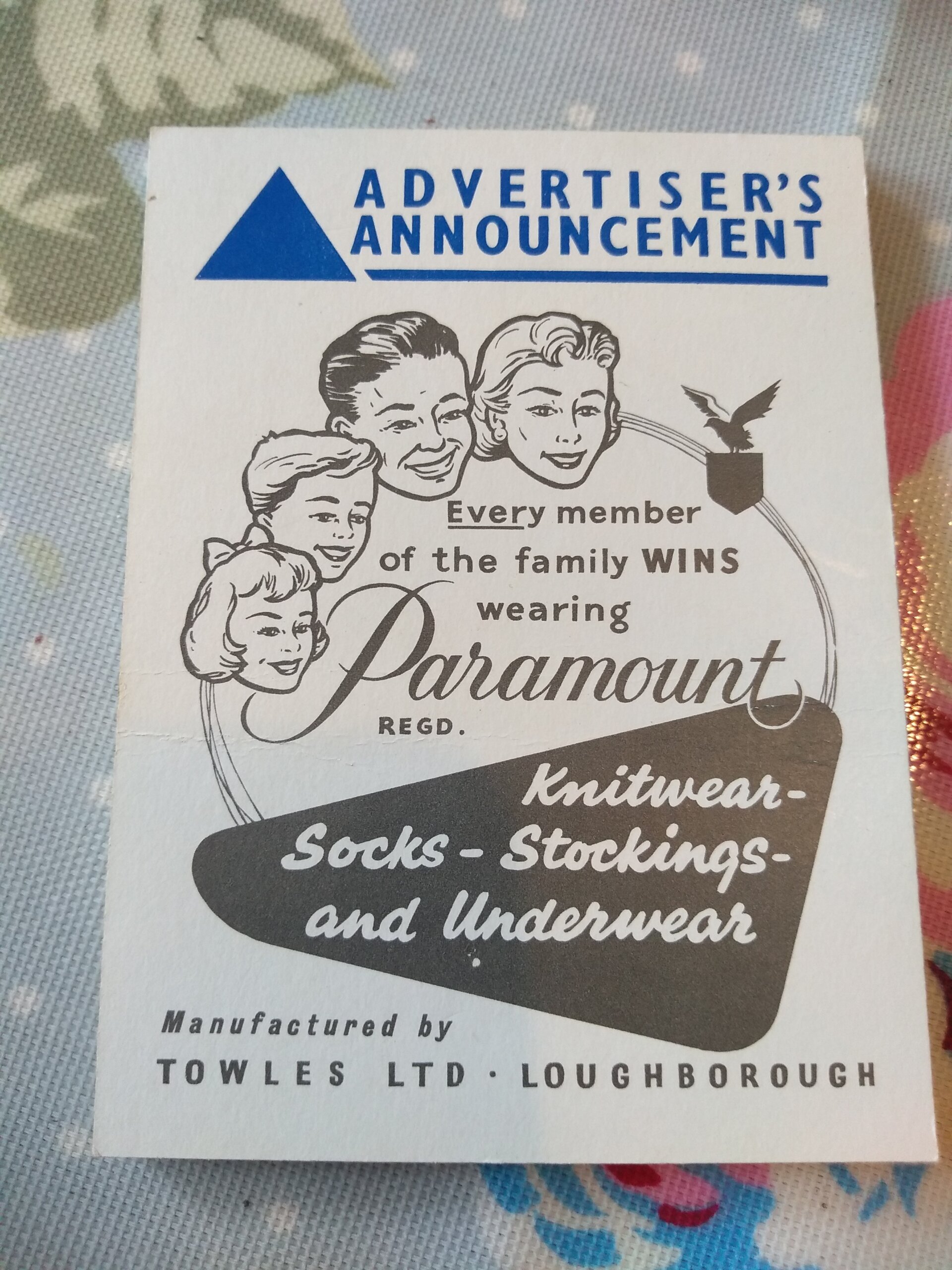
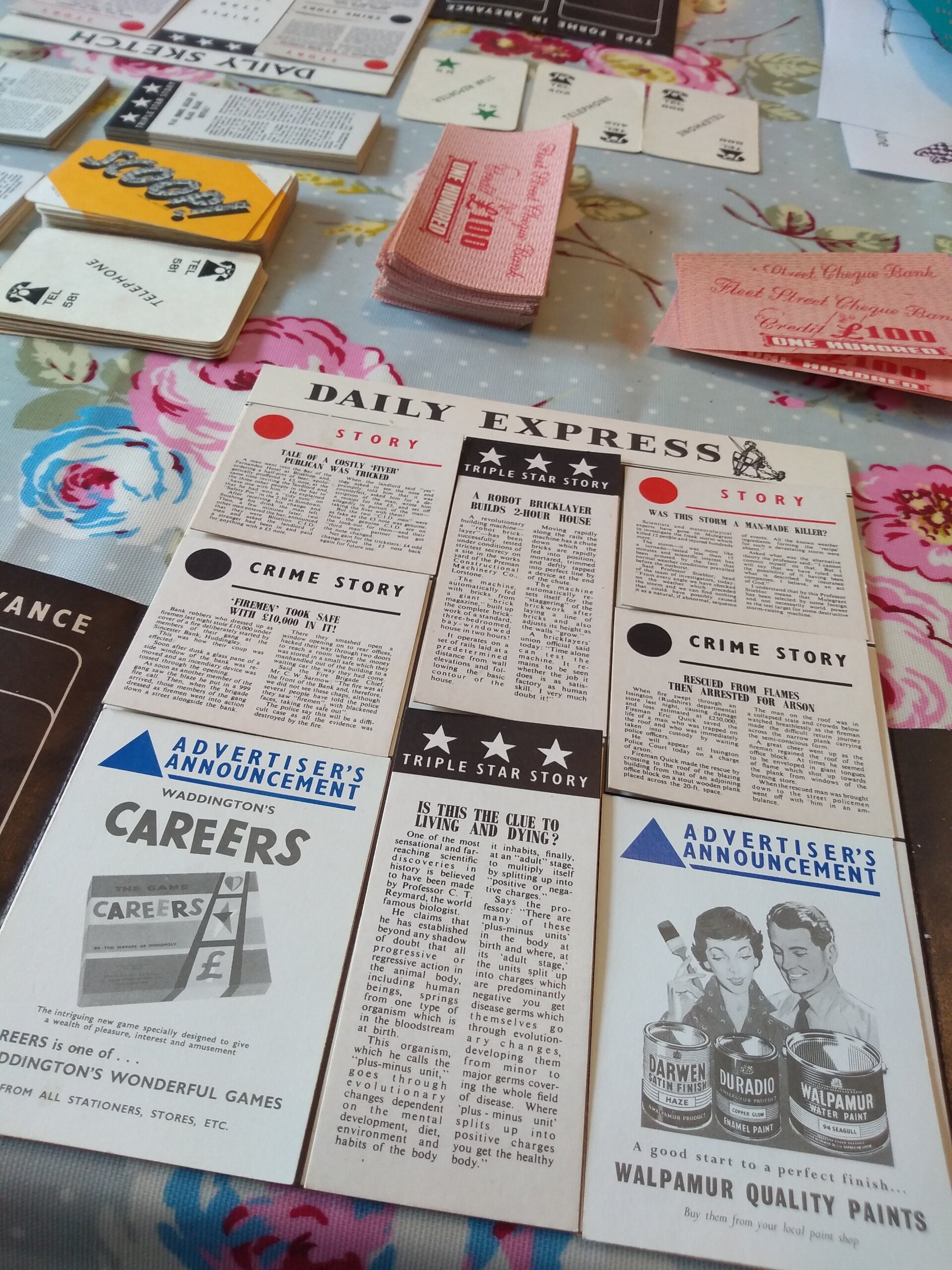
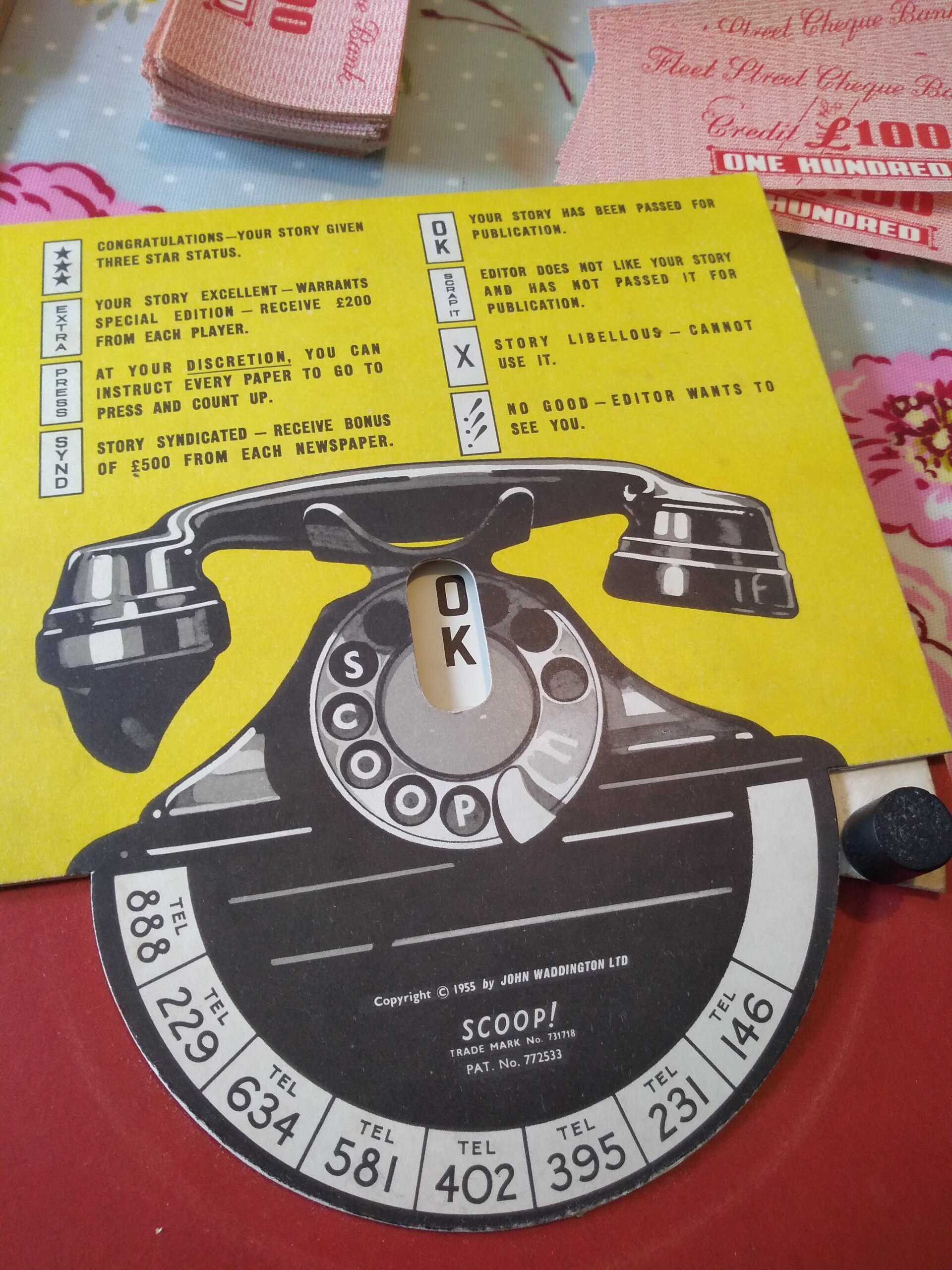
5. Scoop
My obsession with vintage games is creeping in as we reach the top 5 of my Top 10 Games! I’m going to cheat a little here and link you to the youtube video I made about it. It was made in connection with Toy Tuesday at Abbey House Museum where you can see some of these vintage games. If you want to play one just let me know – I usually have some vintage games with me for events but not the more unusual titles.
4. Stellar Leap
Another of my favourite games designers here – Weird Giraffe Games. In Stellar Leap you are exploring space – discovering new planets, populating them and sometimes stealing them from other players all the time managing your resources and keeping an eye on your secret objective. It takes 20minutes per player and plays up to 5 people. It’s been on our favourites shelf for years.
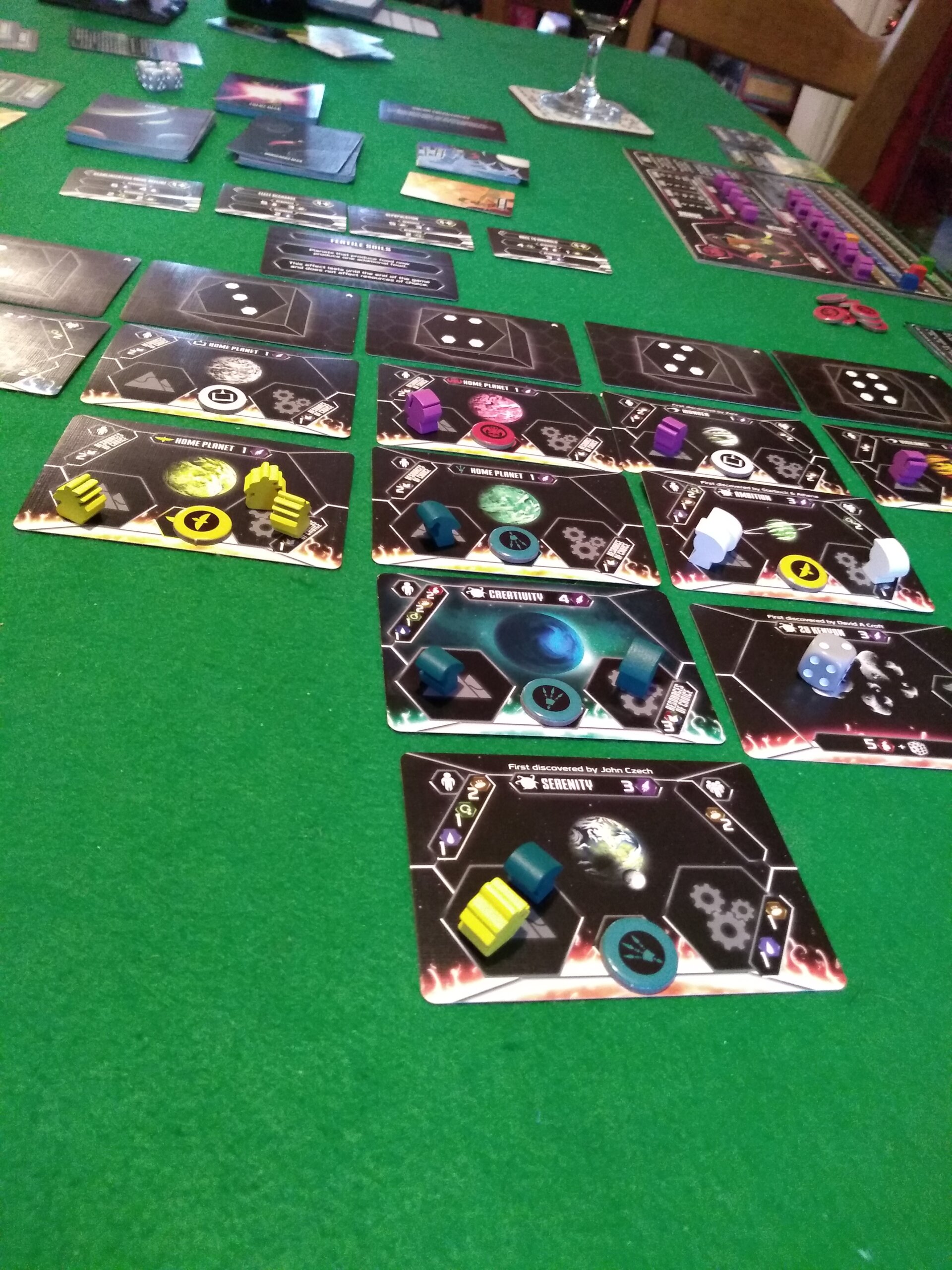
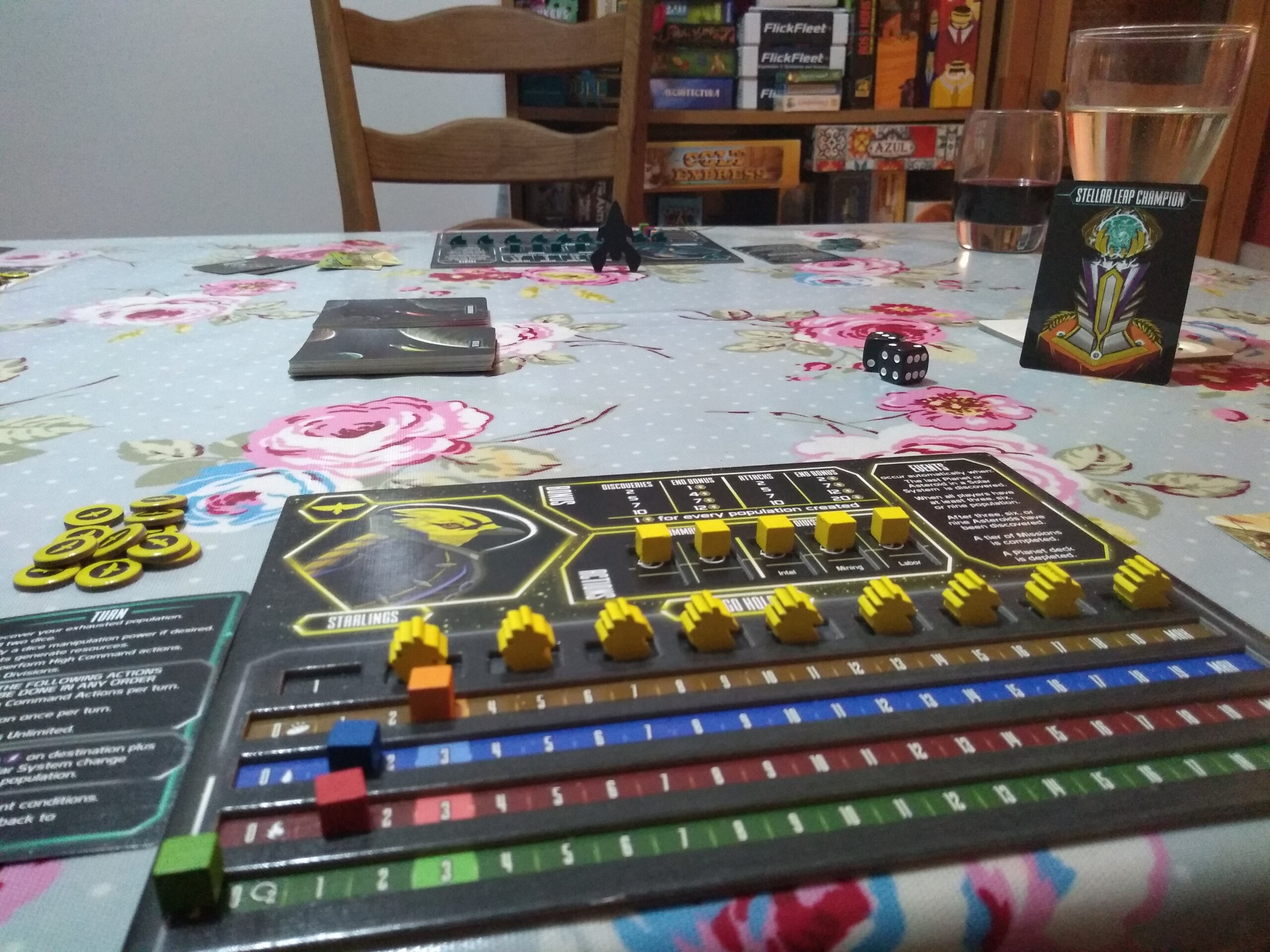
It is very competitive which is unusual for me, but it’s got so many elements that I love. Firstly, a space theme is always welcome in our house. It involves both dice rolling and dice manipulation: each turn you roll the dice to see which planets will generate more resources. Then, you can use either your personal dice power card or the shared one to manipulate the dice and make sure your planet benefits most. You’ll need the resources to travel from planet to planet, plus extra to travel across solar systems. There are missions that are visible to all players and as each one is completed it is removed to reveal a new mission. So, you are racing against others to get to those while also trying to fulfill your own secret trait. You want to keep that hidden as long as possible so that others can’t scupper your plans. I also enjoy the inclusion of asteroids with big yields but risk too. At certain points in the game events are triggered which always complicate matters. It’s a dynamic game where you’ll want to keep refining your strategy and at some points might want to set light to it and go in a completely different direction.
At the end of the game there are loads of things to score which is brilliant because it means there are loads of different strategies and approaches to try. Will you be aggressive and score bonuses for attacks or just discover loads of new planets? Have you focussed on missions and beat everyone to completing them? Have you hoarded resources and cashed them in at the end?
Even just writing about it makes me want to play it immediately and that’s without even mentioning the cute little aliens!
3. Sea Salt and Paper
I was a bit surprised myself that there weren’t more card games in this list. When, I sit down to play a game with folks lately, it is often a card game. Card games are great for when you haven’t got loads of time – they are generally quicker to set up and play. And even ones like this which are built for playing over a number of rounds, if you need to end the game early you still have a clear winner.
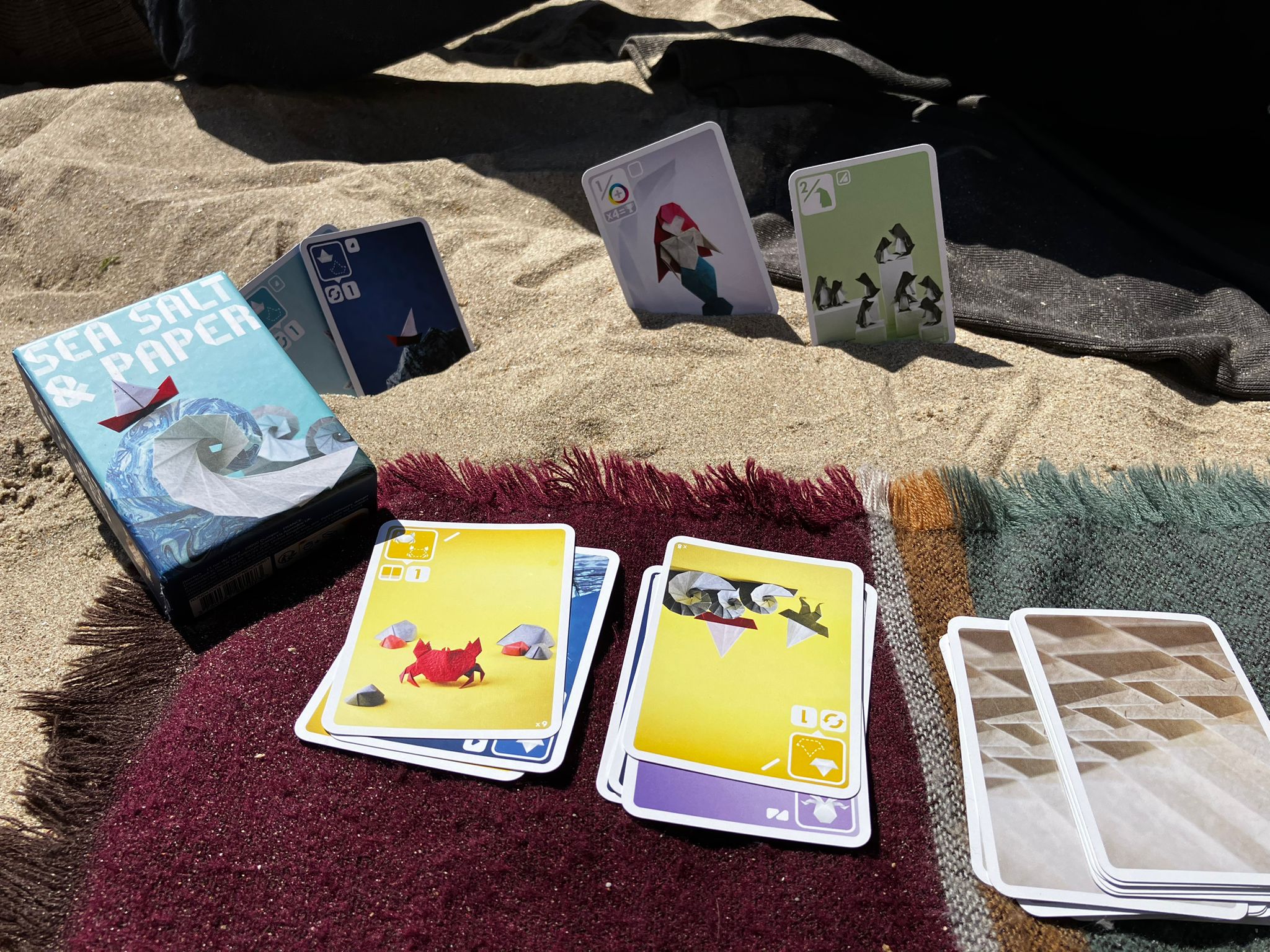
Photos by Zebra Marketing
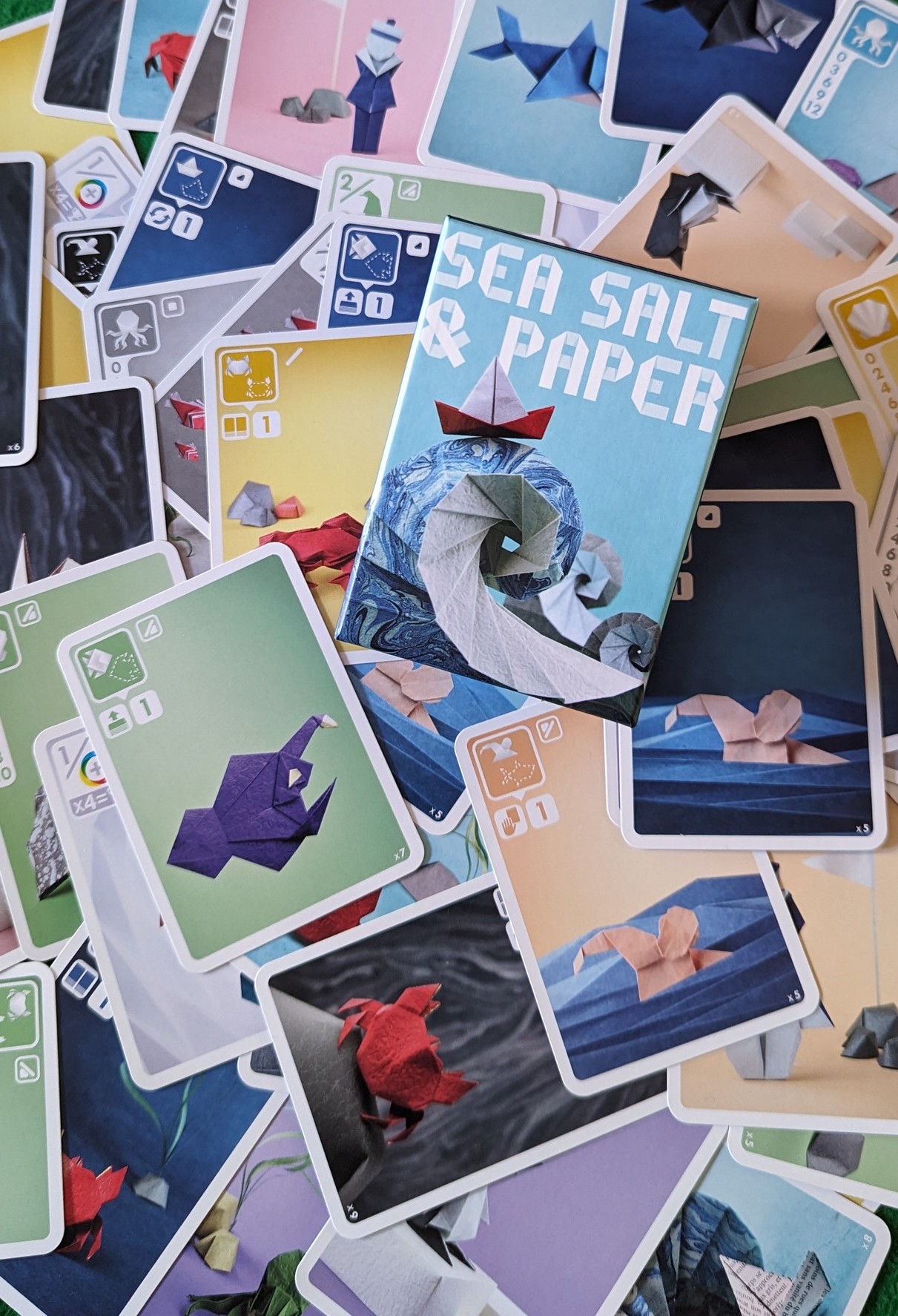
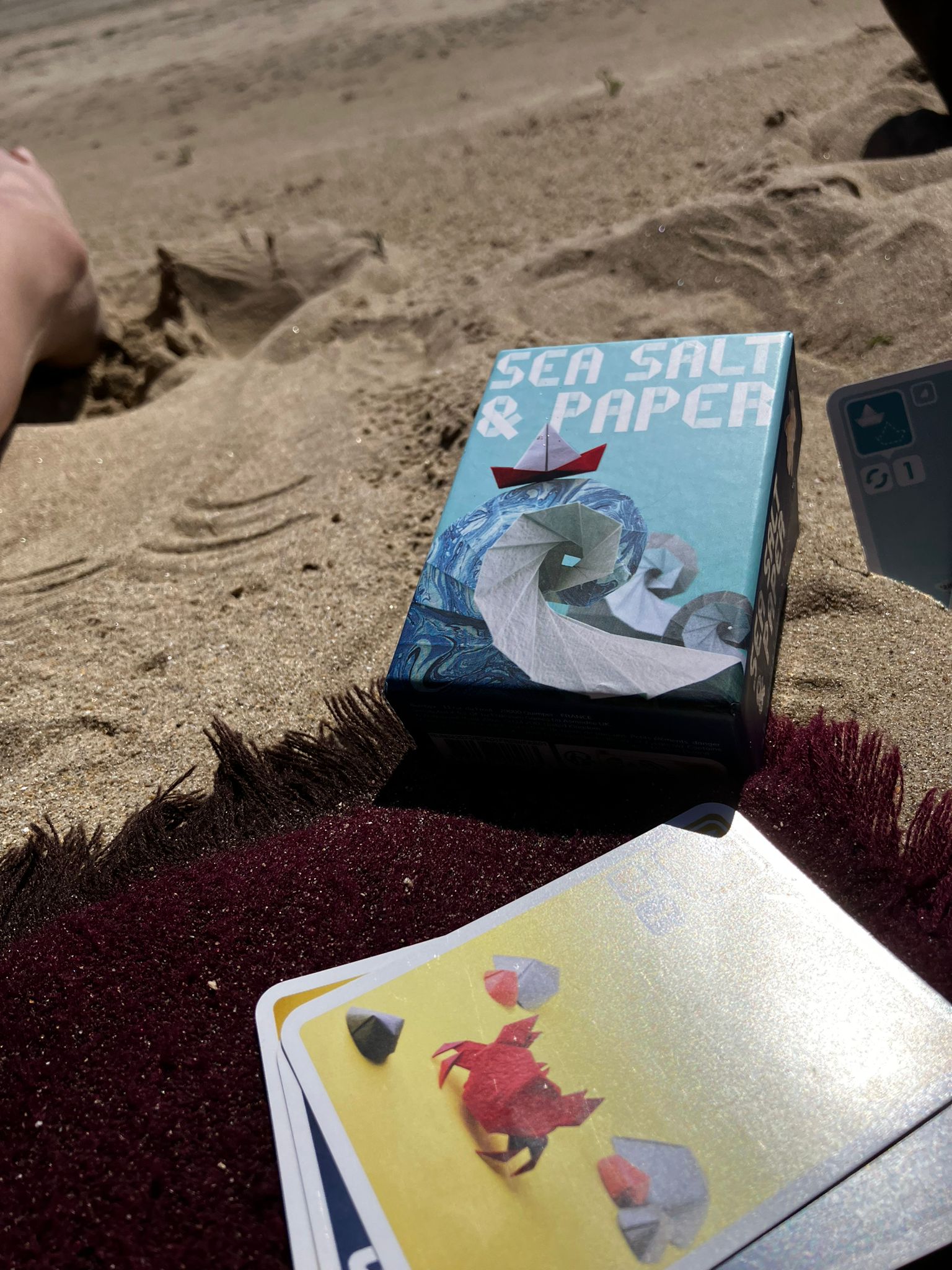
Sea Salt and Paper was an instant hit for me. It’s a great game with gorgeous art work – each card has a unique origami image on it and the symbols in the corner make it clear which type of card it is. So, although each boat is slightly different they are clearly all boats. It also has really clear symbols for people who are colour blind.
You start with no cards and then pick two from the top of the deck, discard one of those or, pick a card from the two face up discard piles. I have said that in some games I like the kind of isolated play but in this one it’s all about knowing your enemy. From the beginning, you know some of the cards your opponents are going for and can sometimes can surmise information by what they discard.
You can collect hidden sets of cards which accrue points exponentially based on how many you have in the set. These remain hidden in your hand until the end of the game. Pairs of cards can be played face up to give you extra actions like: take an extra turn, steal a card, draw an extra card, search the discard pile… You also score bonuses for the sets of colour cards you collect. So, you can kind of see how many points people are on but you never definitely know what’s in their hand. Which brings me on to … ending the round.
Once you have 7 points, you can, if you are brave and confident – end the round. Tot up the points and hopefully if your calculations are correct, you are in the lead. Or, if you are braver still and courageous you can give everyone a ‘last chance’. Everyone but you takes one more turn. Then, you tot up the points. The rewards for this daring strategy are much higher than a normal win but of course… the penalty for getting it wrong is higher too.
It’s in a small box so it comes to a lot of places with me. I can not play it enough!
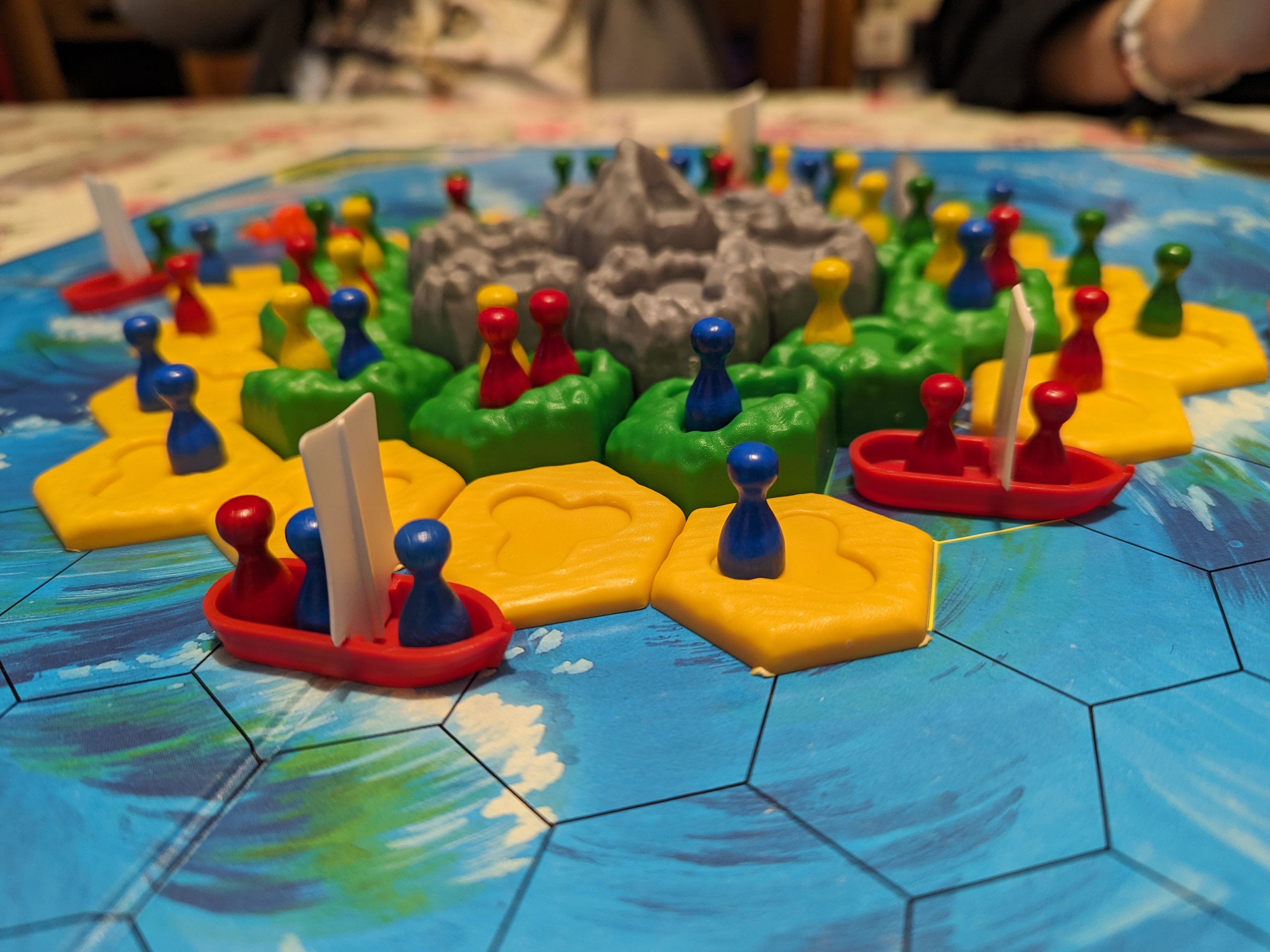
2. Escape from Atlantis.
This has been a firm favourite since I got it for Christmas around 1984. Your job is to rescue your Atlanteans as the island of Atlantis crumbles into the sea and monsters appear (as well as empty boats handily).
Your turn is in three parts. First move three spaces (this movement can be divided between some of your Atlanteans and/ or boats). If you have a swimmer in the sea you can only move them one space per turn. Then, you remove an island piece (all the yellow beaches go, then the green forests and finally the mountainous grey pieces). Flip the piece and see what is on the back – it could be a monster or a boat which you add to the board in its place; or a whirlpool which sucks in everything in the surrounding spaces. Finally (and this is the best bit), swirl the Atlantean swirler. This will dictate how far a monster can move and tip over boats and/ or eat people. The winner is the person with the most Atlanteans on an island when everyone has saved all their surviving Atlanteans.
The keen eyed amongst you will have noticed a dreadful flaw in the benevolent ‘saving all my people’ theme. If you have landed some Atlanteans and kill off everyone else’s and your own, you will win. This, while brutal and mathematically risky, is a perfectly valid way to play.

- Connect 4
An absolute stone cold classic. One of the first games I remember having. Drop the counters in and try to be the first to get 4 in a row. It’s so simple but incredibly replayable, I have no idea how many times I must have played this as a child and an adult. There are so many games based on this premise and often I can introduce a game by saying ‘it’s just like connect 4 but…’ Board games can be intimidating and linking to such a childhood staple that was so accessible can remove that barrier.
Pictured is one copy I bought in a charity shop – a co-operative version perhaps! (I do have other – less yellow – copies if you’d like to play it at an event!)

I think my favourite recent memory of this was when I took it to a group of older folk. Two of them had dementia and were sitting together. One of the facilitators told me that they never join in the activities and instead just sit and enjoy the company of others. I don’t really know what made me choose Connect 4, but I set it up just to the side of them. One of them put the stand between them and without speaking and with no input from anyone, they took turns dropping the tokens in. I kept an eye on them and when the stand was full, I headed over to release the catch to empty the counters. I thought they might not be able to do that. By the time I got to the table, they had released the catch and were sorting the tokens by colour. Then, they played again.
Board games can link us directly back to our childhood, to a simpler time when maybe we weren’t so worried about everything. When we were lying on the living room floor playing games with a sibling entirely focussed on that moment and that game. It’s one of the reasons I love board games and Connect 4 is just the epitome of that.
Honorable Mention: Ouija
The only game in my collection that I have never played and have no intention of actually playing! For that reason it couldn’t make the top 10. But, it is definitely worthy of an honorable mention. It has a interesting history and role in popular culture and personally I have always been fascinated by it.
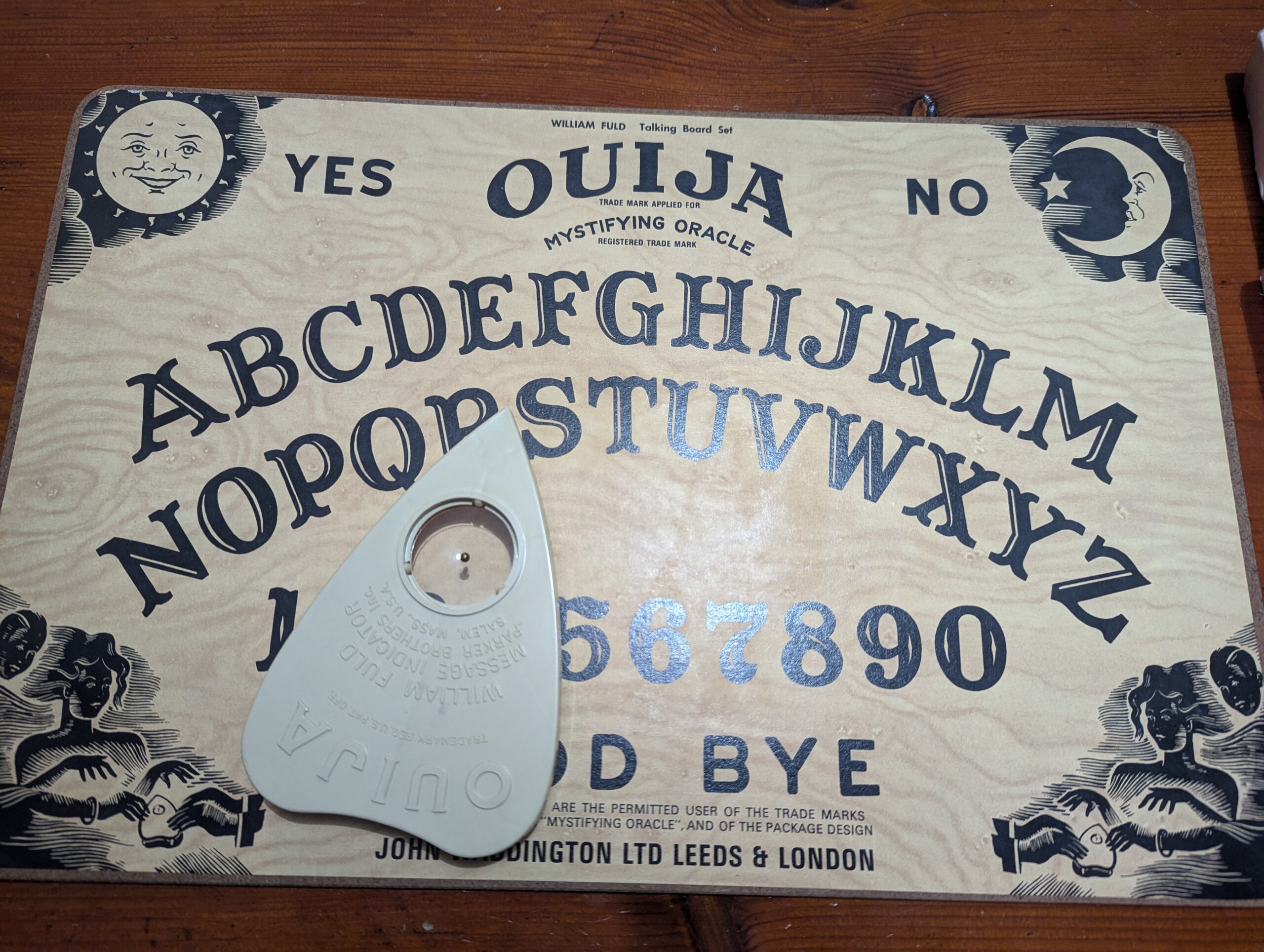
One of the first films that terrified the life out of me and simultaneously sparked a love of horror films was The Exorcist. In the film 12 year old Regan uses a William Fuld Ouija board and contacts Captain Howdy, who soon turns out to be a malevolent spirit. I imagine the spirit talking board was a Parker Bros edition as that would have been readily available at that time. As we are all probably aware, chatting to Captain Howdy had disastrous results including (but not limited to) demonic possession, a spinning head, projectile vomit, and the death of a priest.
Parker Bros popularised the board in the 60s and of course licensed it to their good buddies Waddingtons right here in Leeds and I held out on buying one until I could get a Waddington’s version (even though it is basically the same). The Ouija itself had been around since the late 1800s and spirit talking boards were around for 100s of years before that but it was Parker Bros that cracked the mass market.
Parker Bros marketed their Ouija board as a ‘mystifying oracle’ which has connotations of the endlessly popular Magic 8 ball – in 2015 Mattel even brought out a Magic 8 Ball app. Despite being inspired by a spirit writing device used by the inventor’s clairvoyant mother, the Magic 8 Ball has never had the sinister overtones of the Ouija board. The box of the Ouija board is full of reminders that this is indeed a game – words like ‘entertainment’, ‘fascinating’, ‘fun’, ‘excitement’ and ‘thrills’ give a sense of a fun novelty item. The box hints that the answers are really coming from the users of the board ‘the mysteries of mental telepathy and the subconscious’; but in the next breath warns you not to use it in a ‘frivolous spirit’ or ask ‘ridiculous questions’ as this could invite ‘undeveloped influences around you’. Yet, the board came to be a symbol of something dangerous and worse still ‘ungodly’. There’s nothing like telling us we shouldn’t be doing something to make it instantly more attractive.
A quick google of rules for using a Ouija board, immediately takes you away from the rules on the box and into much spookier territory – you must always say goodbye to the spirit and flip the board face down at the end of a session, you shouldn’t play it in a graveyard, don’t challenge the spirit to prove it’s presence as this may free it from the board… the list goes on. Again, this only serves to incite the curious to experiment with it. But, having said all of that I still haven’t played with my copy and neither has anyone at an event!
If you are looking for some research rabbit holes I strongly recommend this whole area – including the story of the curse of the film. There’s a really interesting episode of the podcast ‘You’re wrong about’ which explores the myth of the curse.
So, there you have it – my top 10. Captured in a moment in time and possibly different if you ask me again. Nonetheless I love these games. What would your contenders for top 10 be?
Ann Jones set up Cards or Die board gaming in 2017 to bring people together with board games. Ann is Autistic, and as well as being passionate about board games she is dedicated to creating inclusive events.
You can book her to teach and recommend games at your event; whether that’s a wedding, corporate event, pub games night or a community group. Or, you can come along to one of her many free events and play games. You can always request games that she has reviewed. Come along to an event and find out more or get in touch to arrange a chat.